
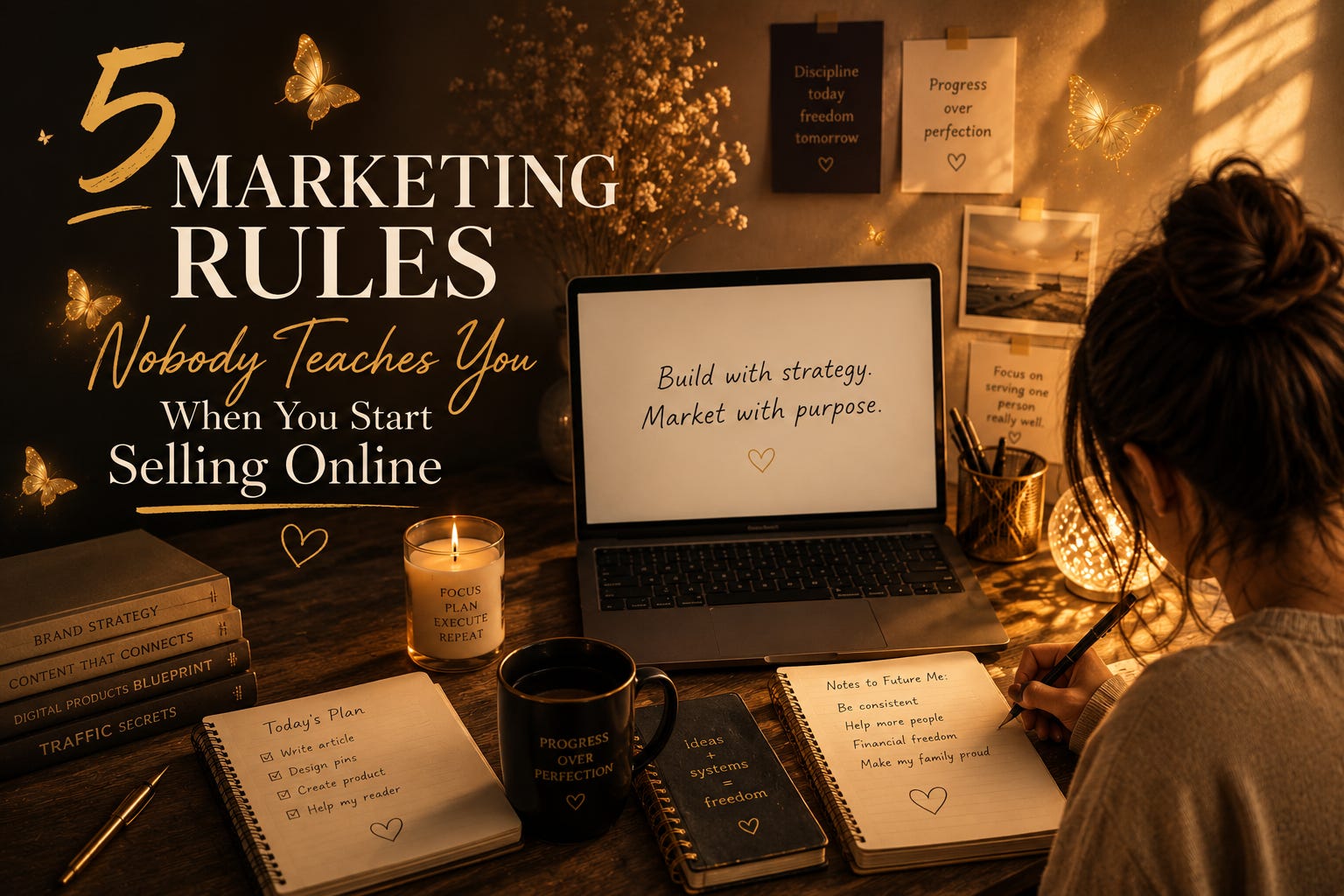
5 Marketing Rules Nobody Teaches You When You Start Selling Online
You can learn them in 10 minutes.

I am going to say something that might make a few people close this tab.
I love AI. I use it every single day. For my articles. My Pinterest. My products.
For basically everything that keeps this faceless business running while I am supposed to be a full-time student who probably should be studying more and going out on weekends like a normal person my age.
I am not doing that. I am in bed at 10pm reading about conversion psychology and taking notes in a Google Doc I will never organize.
I have accepted this is not normal behavior.
If the word “AI” makes you uncomfortable or triggers a speech about authenticity, I respect that.
But this article is probably not going to be your thing.
For everyone still here: I found 5 marketing rules that changed how I think about every article I write, every pin I design, and every product I put out.
Not AI rules. MARKETING rules. Discovered by using AI every day and paying attention to what actually moves the needle.
This newsletter exists to document the faceless journey. Every lesson gets shared so the next person does not waste months guessing the way I did.
If you want this kind of breakdown every week, subscribe to DECODED. No fluff. Just what I am actually learning and applying.
1. Your reader’s own words sell better than yours ever will.
This one took long to figure out.
I used to write pin descriptions from my own head. Smart-sounding sentences about “building a faceless digital business.”
They sounded professional. They also sounded like everyone else.
Then I started going into Reddit threads where real people talk about the exact problems my products solve. Not marketing Reddit. Regular Reddit.
The posts where someone types three paragraphs because they are frustrated and nobody in their real life understands why they want to build something online.
Nobody types “I want to build a faceless digital business.”
They type “I want to make money online but I do not want to be on camera and I do not know where to start and I feel stupid for even wanting this.”
That second version is a pin description. That is a headline. That is an opening line.
I started pulling real phrases from real conversations and weaving them into my hooks and pin copy.
“I feel stupid for wanting this.” “I do not even know what step one is.” “Every guide assumes I already have a following.”
Those phrases do not sound polished. That is why they work.
Marketing is not about sounding impressive. It is about sounding like you were in the room when your reader was talking.
2. If you cannot describe what your content is about in one sentence, your reader cannot either.
I learned this through AI and it humbled me.
When I give AI a vague brief, I get vague output. “Write about digital products” gives me something that reads like a Wikipedia page.
But “write about the moment a faceless creator realizes the product they built was never validated” gives me something with a pulse.
Same principle applies to every piece of marketing. Your pin. Your headline. Your product title.
If YOU cannot say what it is about in one clear sentence, the person scrolling past it cannot either.
Before I publish anything now, I ask: if someone read only this first sentence, would they know exactly what they are getting and who it is for?
If the answer is “sort of,” it is not ready.
Clarity is not boring. Clarity is the reason someone stops scrolling.
One specific message. One specific reader. That is the whole game.
3. Marketing builds relationships. Selling asks for a transaction. You need both but the order matters.
Every piece of content you create is doing one of two things. Building trust or asking for money.
Both are necessary. But the order you do them in is the difference between a reader who buys and a reader who unfollows.
If someone finds my Pinterest pin, clicks through to a blog post, and the first thing they see is “BUY MY PRODUCT,” they are gone.
They do not know me. I have given them zero reason to care.
But if that same person clicks through to an article that teaches them something real, walks away feeling like they learned, and THEN sees “if you want the complete system, it lives here,” that is a completely different experience.
I apply this to everything. My articles are 70% practical valuable information and 30% product mention.
The value always comes first. The product always comes after value. Never before.
A reader who trusts you will buy more than once. A reader who feels sold to will not come back.
4. The fastest way to stand out is to fill the space everyone else left empty.
Every niche is crowded. But crowded does not mean covered.
When I look at other creators in my niche, I do not look at what they built. I look at what they left out.
Every Pinterest guide I found when I started assumed I already had an audience. Left out.
Every digital product course was 27 videos long and built for someone with five hours a day. Left out.
Every “make money online” account was run by someone showing their face and posting five times a day. Left out.
The space they all left empty was the faceless creator with no audience, no time, and no desire to perform.
That is where I built… Not by being better than what existed. By being specific about the part that was missing.
If your niche feels crowded, zoom in. Find the version nobody made yet.
Not because they could not. Because they did not think to.
That gap is your whole angle.
5. Consistency compounds faster than creativity.
The last one. And the one that took the longest to believe.
Before I had a real system, I would write one article and be so drained that the rest of my week would not happen.
No pins. No Notes. No product work. Just one burst of effort and then silence.
That pattern does not build anything.
When I finally built a system that let me show up consistently (same publishing rhythm, same pin schedule, same weekly routine), everything changed.
Not because any single piece was better. Because the consistency itself became the trust signal.
Readers started expecting my articles. Pinterest started understanding my account.
Subscribers started opening every email because they knew something useful would be inside.
Consistency is boring. Nobody makes a reel about “I showed up again this week.”
But consistency is what every platform rewards. The algorithm is not looking for your best work. It is looking for your most reliable work.
A good article every week beats a perfect article once a month. Every time.
These five rules did not come from a course...
They came from doing this every single day, making mistakes, watching what worked, and writing it down before I forgot.
If this is helping you see things differently, drop your thoughts in the comments. I want to know which one landed and which one you are going to start applying first.
Pinterest is where my first sale came from. Completely faceless. No audience. No following.
And the difference between “I have been pinning for months and nothing is happening” and “someone just bought my product from a pin” is not talent.
It is knowing exactly what types of pins to post, how to write them so the right person stops scrolling, and how to structure 1 to 2 hours a day into a system that builds traction instead of wasting time on random posts that look pretty but do nothing.
The Copy-Paste Pinterest System is that structure.
It is the difference between guessing what to pin and knowing.
Between spending months piecing together free advice from ten different YouTube videos and having one system that tells you what to do today, tomorrow, and for the next 30 days.
I built it because I was the girl doing it the slow way. Posting pins that got impressions but no clicks.
Wasting weekends on a strategy that was not a strategy at all.
This is the system I wish I had before all of that. And it was built for someone with no audience, no face on camera, and no more than a couple of hours a day to make this work. Grab it below!
Before you go…
Which of these 5 rules landed hardest? And if you are using AI in your business right now, what is the one thing you still refuse to let it do for you?
Tell me in the comments. I am genuinely curious.
I read every comment. Always.
P.S. Not there yet? Start with Pinterest From Zero: The Beginner’s Faceless Digital Marketing Guide.
It is free and it is where I wish I had started instead of spending three months figuring it out alone. Grab it here
This is a gteat read with so much information ive never done pintrest i write on substack im 53 and just starting out i write a newsletter.helping over 40s start a side hustles from my own side hustling experiance
I really love this down to earth view. Thank you for keeping it simple 😁.