
I Followed a $5,000/Month AI Digital Product Blueprint. Here Is the Actual Money I Made.
The stripped-down framework a full-time student can actually use.

Every faceless creator on YouTube is promising you $5,000 a month from AI digital products.
They put the number in the thumbnail. They wave it around at the two-minute mark.
Most of the frameworks, if you strip out what actually works, will not make you $5K next month.
But they will make you something. And when you have not made a dollar from your own work, something is the number that matters.
I know because I watched one of those videos. Rolled my eyes at the $5K claim.
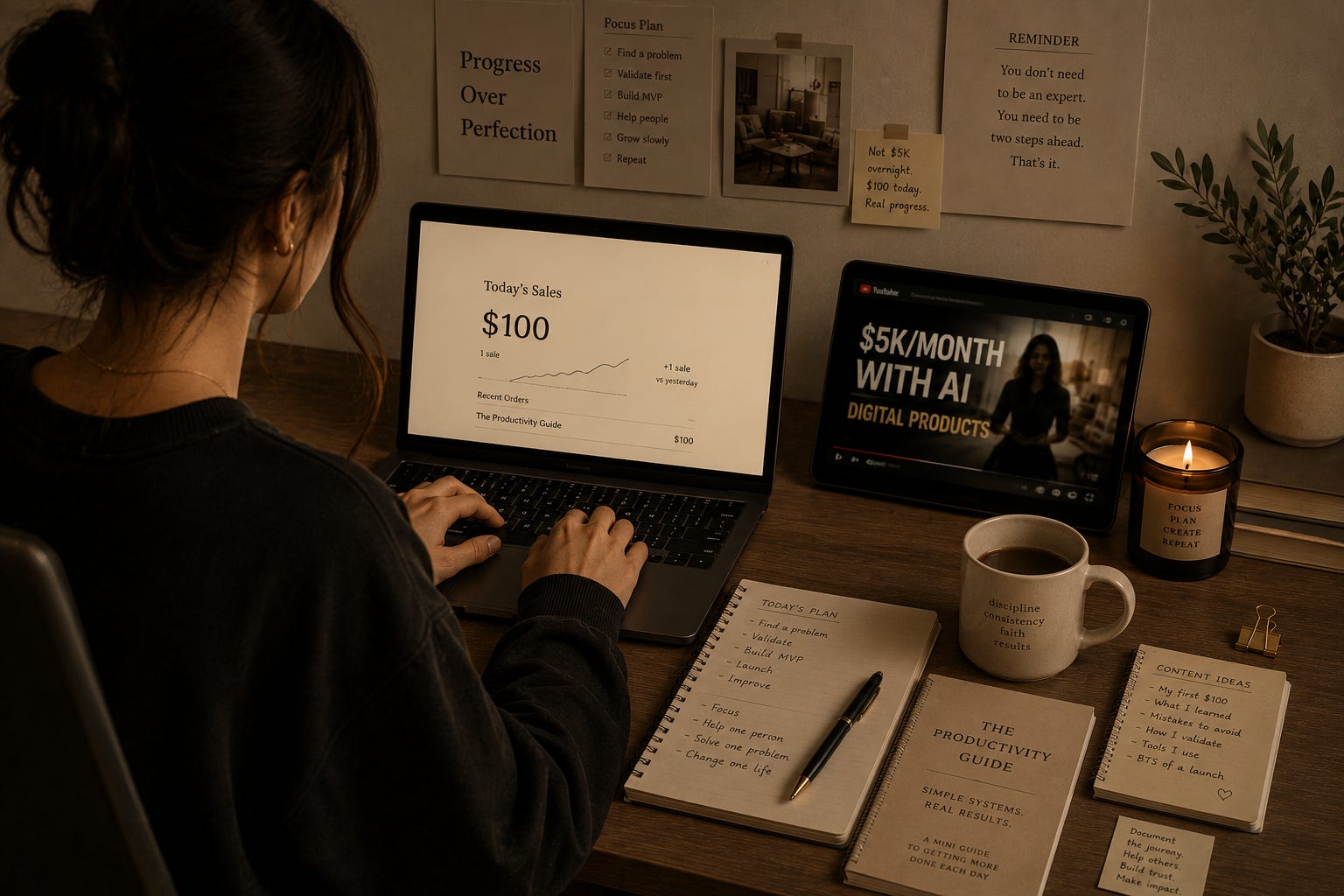
Tried it anyway, cutting the parts that felt inflated. Six weeks later I had made an extra $100 as a full-time student.
Not five figures. One hundred dollars, on top of a full course load, from tiny AI-built PDF’s that took me an afternoon to put together.
Let me show you what actually worked. And what I skipped, but first .. take a moment to subscribe below⬇️.
You do not need to be an expert. You need to be two steps ahead.
The first thing most creators get wrong. They wait until they feel like an expert to sell anything.
That day never comes. You will always feel one step behind someone.
Which is the whole point.
You are not selling to people at your level. You are selling to people two or three steps behind you.
What you already know, what you figured out last month, what took you fifty hours and now feels obvious, is exactly what your buyer needs.
Ask three questions. What do friends and family come to you for advice about. What problems have you solved for yourself in the last year. What feels easy to you that seems hard to other people.
Then narrow. Do not try to solve “how to be productive.”
Solve “how to organize your day using the notes app on your phone.”
Specific problems have specific buyers. Vague problems have no buyers.
Validate before you build. Every single time.
This is where 95% of digital products die. Someone gets excited about an idea, spends three weeks building it, launches it, and gets nothing back.
Not because the product is bad. Because nobody wanted it in the first place.
The rule I follow now. Before I build anything, I check that people are already paying for solutions to that problem somewhere else.
I look at what is already selling in the space. I check how many customers similar products have. I read reviews for what is missing.
Three or more products selling something adjacent to my idea means the market is real.
Then I build the version that fixes the top complaints.
The rule is boring. It is also the difference between a product that sells and three weeks of your life gone.
The 48-hour test
Every part of what I just described has a system underneath it.
Which questions to ask. Which signals actually mean the market is real, and which are noise. Which complaints in reviews are worth building for, and which will trap you into building a worse version of what already exists.
That is what I put inside Will It Sell? The 48-Hour Test. The exact validation system I run every time I have a new digital product idea, before I let myself build anything.
Two days from idea to a clear yes or no. No spreadsheets. No guessing. No three-week rabbit hole ending in silence.
If you have an idea sitting in your notes app right now that you keep almost starting, this is the test that tells you whether to build it.
Build the MVP with AI. In an afternoon.
The old way. Weeks of planning. Endless revisions. Perfect design. This is why most creators quit before shipping.
The new way. You build a minimum viable product. Not a masterpiece.
Something that solves the exact mini-problem you validated, in the shortest format that works.
A ten-page PDF beats a hundred-page yapfest. Buyers do not want length.
They want the transformation.
AI does most of the heavy work. I use Claude to outline, draft sections, structure pages.
My job is judgment. What stays, what gets cut, what phrasing sounds like me instead of a chatbot.
Then I drop it into a Canva template, export as PDF, done.
The whole thing takes an afternoon. Not a month.
Personal brand comes with the work. Not before it.
You do not need a personal brand before you start. You need to start, and let the brand build itself around what you are already doing.
But every person online is building one, whether they realize it or not.
Every post, every pin, every product page teaches your audience who you are and whether to trust you.
Positioning, clear communication, actual trust are not optional. Just less flashy than the guru version.
If you want me to break down how I learned to do this without ever showing my face, drop a comment⬇️.
If there is enough interest, that is next week’s article.
Documenting is how beginners become the person someone else follows
I am not going to pretend I am a beginner anymore. I have been building on Pinterest and in digital products long enough now that most of this feels natural.
But I remember when none of it did.
Which is exactly why, if you are just starting, this is the move.
Document what you are learning as you learn it. Turn your findings into content.
Not because it is polished. Because someone one step behind you needs the map you are drawing right now.
That is how you become the scout for the next person. And how you build an audience before you have a single sale.
The $100 was the number that mattered
Not because $100 is a lot. Because it was the first dollar my own work made.
Proof the whole thing was not theoretical.
Real buyers on the other end of a validated idea, an AI-built PDF, and a landing page I made in one sitting.
$5K a month is real for people who have been at this for years with audiences behind them.
$100 in six weeks is real for someone starting from zero with two hours a day.
Both are true. Only one is honest for where most of us are.
Before you close this tab
If honest breakdowns of what works when you are a faceless creator with limited hours are what you want in your inbox every week, that is DECODED. I share the numbers, the working method, and the part that did not work first. Subscribe below.
The $5K thumbnail is the pitch. The $100 as a full-time student is the truth.
Start with what you already know. Validate before you build. Ship the smallest version. Let the brand build itself while you work.
If anything here resonated with you, share it in the comment below….
P.S. The AI prompt I use to build every new digital product I sell is now a free four-page playbook.
It is called The AI Prompt That Builds Your Next Digital Product, and it walks you through the exact structure, the sections to include, and what to tell Claude so the output actually sounds like you instead of a chatbot.
Grab it here
I’ve always found the validation part to be difficult. So lately for me it’s been working well to find people I know who could use the Notion templates I created and then tweak it specifically for them. That way I continue to learn, but have a product they’ll actually use and can give me feedback on.
Interesting thank you 🔥