
Less Posting. More Reach. 2 Pins, 1,000+ Impressions Each.
The exact framework that turns minimal effort into maximum reach.


Everyone’s screaming “post 10 pins a day!” and honestly? I’m tired just reading that.
I used to buy into that myth too.
More pins = more traffic, right?
Wrong.
Last week, I created pins for the full week like I always do, but 2 of them absolutely exploded.
Pin #1 hit 1.03k impressions with 32 clicks.
Pin #2 hit 1.26k impressions with 19 clicks. Both went viral within days.
Here’s what I did that nobody talks about.
Quick poll before we dive in:
Vote below I use this to create products and content that actually solve your problems:
Your vote shapes what I build next.
I read every result and use them to create systems that work for what you're actually stuck on, not just what I assume you need.
Takes 2 seconds—I'll be grateful if you vote!
NOW, Let’s get into into.
Let’s Talk About What Actually Counts
Can we be real for a second? Impressions are cool for screenshots and ego boosts, but your bank account doesn’t care about pretty numbers.
You can have 10k impressions and 3 clicks. Useless.
Or you can have 1,000 impressions and 32 clicks. Goldmine.
The difference? Strategic pins that make people think “I NEED to click this right now” instead of just “oh, that’s pretty.”
Most Pinterest advice focuses on volume. Post more. Pin daily. Batch 50 pins at once.
But nobody teaches you how to make pins that actually convert impressions into outbound clicks the metric that feeds your email list, drives traffic to your offers, and builds your faceless business.
These 2 pins worked because I stopped chasing impressions and started optimizing for clicks.
Let me show you exactly what that looks like.
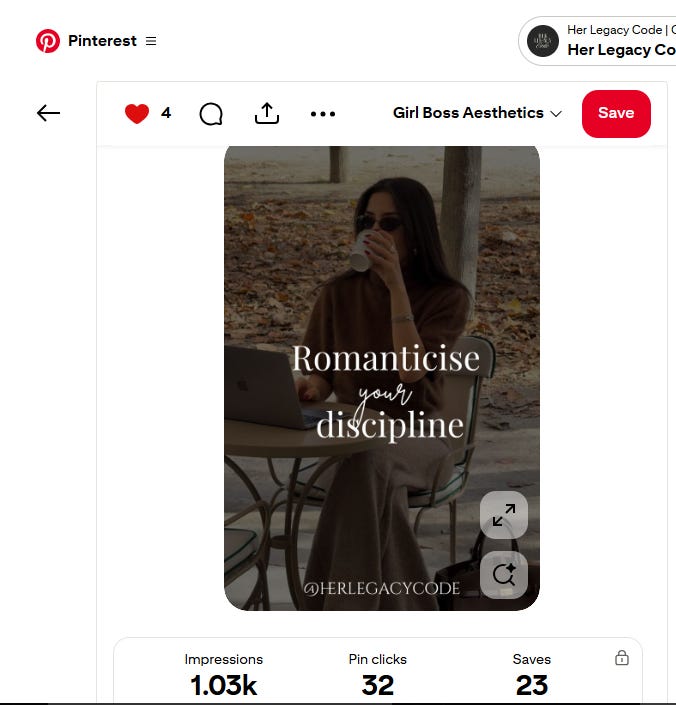
The Stats: 1.03k impressions, 32 outbound clicks, 23 saves
This pin wasn’t trying to be perfect. It was trying to solve one specific problem: people know they need discipline, but it feels boring and heavy.
Why it worked:
The headline “Romanticise your discipline” created a curiosity gap.
It’s unexpected.
Most productivity content screams “hustle harder” or “get disciplined NOW.” This pin whispered something different what if discipline could feel good?
The design was simple, just a moody aesthetic photo with clean text overlay.
Why does this matter? Because Pinterest users scroll on mobile.
If they can’t read your pin in 2 seconds, they’re gone.
The pin linked to content that delivered on the promise on one of my substack post not just my homepage or some random blog post.
That’s the bridge Pinterest users need: promise something specific, deliver immediately.
The Real Secret: It’s about pins that interrupt the scroll and make someone feel like “finally, someone gets it.”
That’s what this pin did. It acknowledged the struggle (discipline feels hard) and promised relief (but it doesn’t have to).
That’s conversion psychology, not just design.
PIN# 2
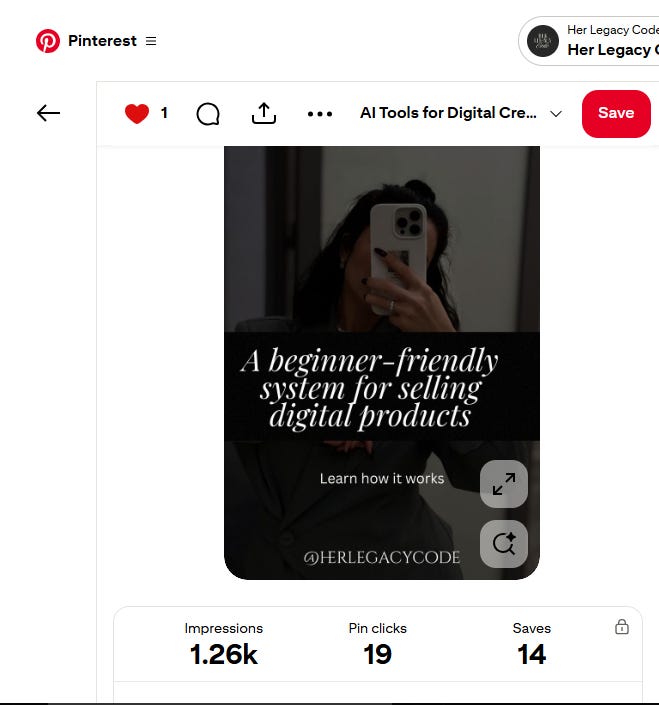
The Stats: 1.26k impressions, 19 outbound clicks, 14 saves
This one performed even better in impressions, and here’s why: it spoke directly to a specific pain point.
Why it worked:
The headline was clear and targeted.
No “guru speak.” Just a direct promise.
The design followed the same principle as Pin #1—simple, readable, mobile-friendly.
Dark background, white text, a moody photo that fit my brand aesthetic.
Consistency matters because when people see your pins in their feed multiple times, you want them to recognize you instantly.
The CTA “Learn how it works” wasn’t pushy. It was inviting.
It said “I have something helpful, come see.”
That’s the difference between a pin that gets ignored and one that gets clicked.
What made this different:
This pin linked to post again a free resource that walks beginners through the exact steps. Not a sales page. Not a vague blog post.
A genuinely useful articlethat builds trust before I ever ask for a sale.
And that’s the strategy most people skip. They link straight to their product and wonder why nobody’s buying.
Pinterest users aren’t ready to buy from you yet. They need to trust you first.
The Pattern You Need to See
Notice what both pins have in common?
Clear headline that solves a specific problem
Simple design that’s easy to read on mobile
Strategic link to something valuable, not just “my homepage”
Emotional hook that makes people feel understood
Again……..This isn’t luck. It’s a system.
I didn’t create these pins hoping they’d go viral.
I created them using a framework I’ve tested and refined over months of trial, error, and tracking what actually works.
Why Most Pinterest Advice Fails You
Here’s what drives me crazy about Pinterest advice: everyone tells you to “just post more pins.”
But nobody teaches you HOW to make pins that convert.
They show you Canva tutorials and say “make it aesthetic.” Cool.
Now what? How do you know if it’ll actually get clicks?
How do you write descriptions that rank in search?
How do you choose which content to link to?
That’s the gap. And that’s why most people burn out on Pinterest before they see results.
The real strategy isn’t about volume. It’s about intention.
What makes a pin “click-worthy”:
It speaks to a specific pain point
It promises a clear outcome (not vague “learn more”)
It links to something that delivers immediately (not your homepage)
It’s designed for skimmers (mobile-first, easy to read in 2 seconds)
I wasted 3 months making “pretty pins” that got zero clicks.
Then I shifted to this method strategic pins that do ONE job: get the click. Everything changed.
This is exactly why I created The Copy-Paste Pinterest System.
Not another “make pretty pins” course.
A system that teaches you how to create pins that convert—in 1-2 hours/week, without showing your face, without needing thousands of followers.
Here’s What You Actually Need
You don’t need to reinvent the wheel. You need a system you can follow.
The essentials:
✓ A simple pin design template (not 47 fancy ones just 2-3 that work)
✓ A headline formula that creates curiosity + promises an outcome
✓ Pinterest SEO basics (keywords in the right places, not stuffed randomly)
✓ A landing page that delivers on your pin’s promise
✓ Time to batch (1-2 hours/week, not daily posting)
That’s it. Seriously.
The reason these 2 pins went viral wasn’t because I spent 8 hours on them.
It’s because I followed a proven framework that prioritizes clicks over aesthetics.
Let Me Be Honest With You
This won’t work if you’re not willing to be strategic.
It’s not about posting more it’s about posting smarter.
You’ll need to track your analytics weekly (I’ll show you which 3 numbers actually matter).
And yes, it requires consistency, but way less time than you think.
One batching session. 2 hours. Pins scheduled for the week.
That’s the reality of faceless Pinterest marketing when you have a system that works.
If you’re tired of guessing what works on Pinterest and you want a system that’s already proven (like, literally last week), The Copy-Paste Pinterest System is exactly that.
It’s not a “motivation dump.”
It’s the step-by-step method I used to create these 2 pins and every pin that’s gotten me results since January.
Templates. Headline formulas. Pinterest SEO breakdown. Analytics tracking. Landing page strategy. The whole thing.
Built for introverts with 1-2 hours/week who want outbound clicks, not just pretty numbers.
Questions? Shoot me a DM. I read every single one.
If this hit different and made you realize you've been overcomplicating Pinterest this whole time, drop a comment and let me know.
I read every single one.
And if you want more of this real talk about Pinterest, digital products, and building income without losing your mind—hit that subscribe button.
I’m sharing everything I learn, every mistake I make, and every win (big or small) as I figure this whole thing out.
P.S. The best part? You don’t need thousands of followers to make this work. It’s about the pins, not the audience size.
The system shows you exactly how.
I've never even considered Pinterest beyond looking at pretty pictures. This post has given me lots to think about. Thank you!
Pinterest is definitely under utilised.
Love the actionable steps 🙌